


Donkey trekking is attracting more and more families looking for a different kind of holiday, closer to nature. But when travelling with an animal, one question inevitably arises: is the donkey being well treated?
To address this question with clarity and honesty, Safrantours chose to give the floor to three partner donkey handlers, who have been working alongside donkeys for many years and welcoming families for a few days of donkey-supported itinerant travel.
Karine in the Drôme, Martine in Ardèche, and Rachel on the Larzac share their daily lives, their experience and their perspective here through a cross-interview. A moving and sincere insight into what unfolds when people meet this particularly sociable animal, as they set off for a few days of hiking with a donkey.
Why choose a donkey trek for a family holiday?
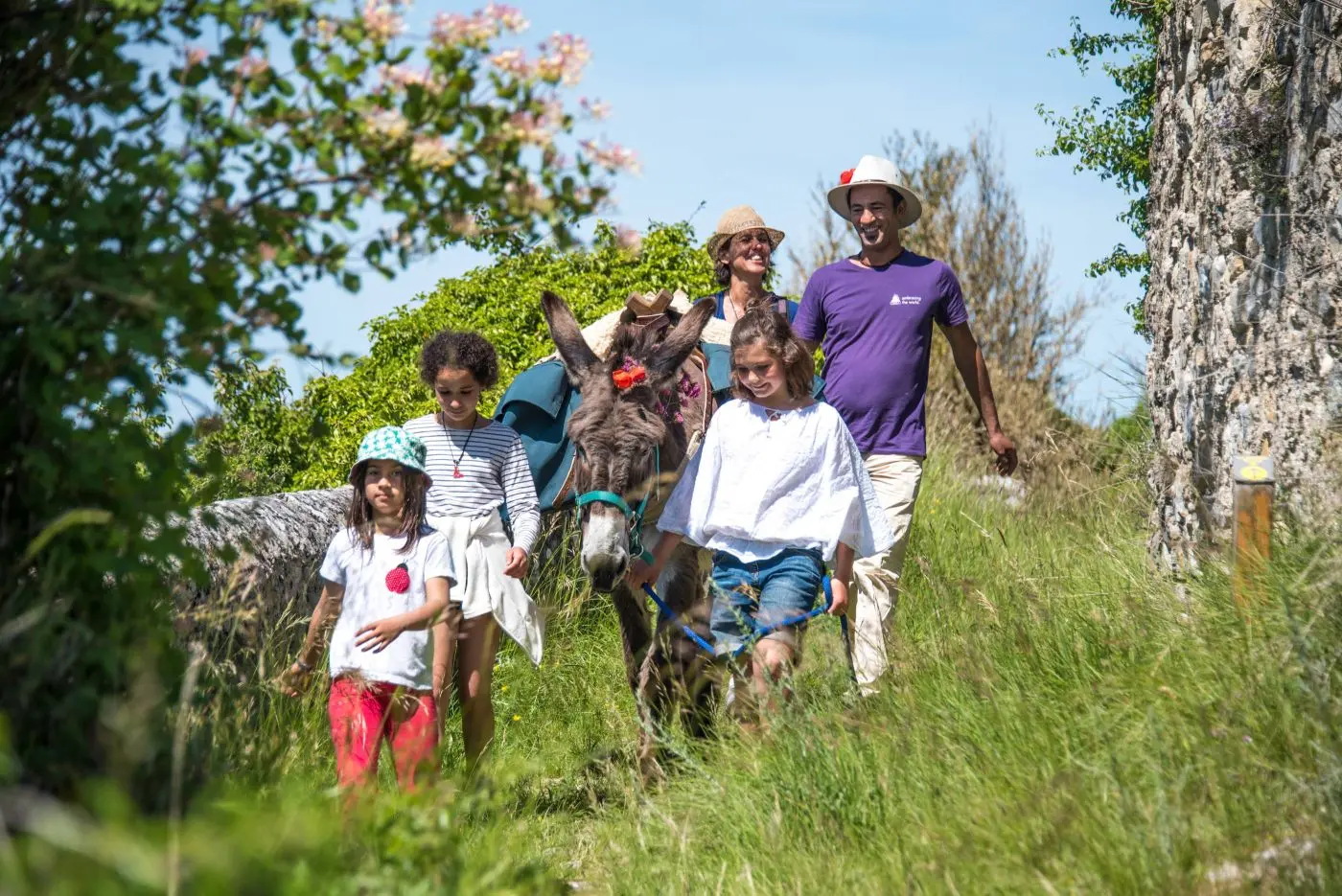
Even before talking about routes or landscapes, all three donkey handlers mention the animal’s natural rhythm. A rhythm imposed by the donkey itself, which transforms the way of travelling by inviting a slower pace.
Karine (Drôme) “Donkey trekking is above all a calming experience. The donkey sets a slower rhythm. Even when it is lively, it encourages families to slow down, to observe, to be together. It’s not about performance, but about sharing.”
Martine (Ardèche) “Hiking with a donkey means living a real story with the animal. Children become attached very quickly and realise they have a responsibility. You don’t just go off ‘to do a hike’ — you share an experience of the journey.”
Rachel (Larzac) “The donkey creates an immediate bond. It is a true travelling companion. Family donkey trekking transforms the relationship to time, and often the relationships between people themselves.”
In the view of all three donkey handlers, these holidays with a donkey leave a lasting impression. Far more than a simple memory, they become a shared experience, often talked about long after returning home.
What actually happens before setting off on the hike?
A hiking stay with a donkey is never improvised. Even before the first step, time is set aside to prepare both the animal and the families themselves.
→ A hiking stay with a donkey is never improvised, as shown by our itinerant journeys designed specifically for families.
Martine “There is always a preparation phase. I ask families to arrive the day before in order to choose the donkey that will suit them best. I select the donkey according to the children’s age, their walking experience and their energy levels. Then I prepare the donkey: the hooves are checked and cared for, and I fit the harness. The panniers are carefully adjusted, with weight kept to a minimum, to ensure the animal’s comfort and well-being.”
Rachel “Before each hike, I carefully examine the donkey and get it moving again. I also make sure that the families’ expectations are realistic, both for themselves and for the animal. The right balance needs to be established from the outset to guarantee a respectful, reciprocal experience.”
This preparatory time is essential to build trust and to establish a clear framework based on animal welfare throughout the stay.
How can you ensure the donkey’s well-being during a stay?
Respect for the animal lies at the heart of every hike with a donkey.
Karine “The herd is fundamental for a donkey. It is the group that allows it to remain alert and calm. On its own, it does not feel safe and cannot truly rest. On a hike, humans become its herd, especially on terrain that is unfamiliar to it. We need to stay together, attentive and present.”
Rachel “We pay close attention to water, breaks and fatigue. The donkey’s pace always comes first. If it needs to stop, we stop. We never force it.”
Martine “Overnight stops are chosen with care. On arrival, the donkeys have access to enclosures, water and hay. This rest time is essential for their recovery.”
Travelling with an animal means accepting its needs, its limits and its rhythm. That is also what gives the experience its full depth.
What care do donkeys receive on a daily basis, outside of hiking periods?
Donkey care does not stop when the hikes end. It is rooted in daily, patient and consistent attention.
Karine “The most common mistake is feeding. Donkeys originate from Africa; they are not suited to rich land. Here, they are always on the move, on poor soils, with shelters and appropriate hay. This allows them to stay healthy in the long term.”
Martine “There is fence management, hay, health monitoring, the farrier, vaccinations. Like with any animal, but with a great deal of attention.”
Rachel “I go and see my donkeys every day. You immediately notice if something isn’t right. This daily vigilance is essential.”
Aren’t the donkeys tired by the hikes?
This is a common question among families, who do not always dare to ask it.
Rachel “The donkeys I work with are used to hiking. They don’t go out every day, they have rest periods, and above all, they only work as long as they are willing and able.”
Martine “A tired donkey is easy to spot. In that case, it doesn’t go out. It’s as simple as that. We always adapt the frequency of departures according to the donkey’s age and the terrain.”
Karine “A donkey can accompany hikers until the age of 25, sometimes even longer, provided its natural needs are respected. They are hardy, frugal animals that age well when they are not forced.”
A well-supervised donkey journey in France is based on respect for the animal, its willingness and its physical condition. Hiking is never an imposed constraint, but a chosen, supervised and limited activity.
What should you do if a donkey stops or refuses to move?
This is probably the situation parents fear the most, especially during a first hike with a donkey.
Rachel “It happens, and it’s normal. The donkey may be afraid of an obstacle, tired, or simply need time to understand. You have to give it time and reassure it. Our donkeys are used to hiking and, in the vast majority of cases, they are happy to set off walking.”
Karine “Forcing a donkey is the worst thing you can do. It withdraws and shuts down. If you observe and reassure, the situation almost always resolves itself.”
Martine “Travelling with a donkey means accepting responsibility, like having one more child to look after. You have to be attentive, aware that you are sharing the path with an intelligent and sensitive animal.”
Often feared, this situation becomes a real open-air lesson, especially for children: learning to wait, to observe, to listen to a living being instead of becoming impatient. It is no longer a problem, but a learning experience in respect and attentiveness to others.
What are the benefits for families of travelling with a donkey?
All three donkey handlers agree: travelling with a donkey has something special and deeply moving about it. It is neither spectacular nor intense. Rather, it is an experience of reconnection — to one’s family, to the animal and to nature.
The slowness that characterises this social and endearing animal gradually spreads. It encourages deeper attention to what is present, to what surrounds us, step by step, as people reconnect with one another.
Rachel has observed this turning point for years: “Families come back calmer. There is a lot of emotion when it’s time to say goodbye to the donkey. It’s not just the end of a hike, it’s the end of a relationship that has been built day after day. It brings real serenity. And without the donkey, that rhythm simply wouldn’t exist.”
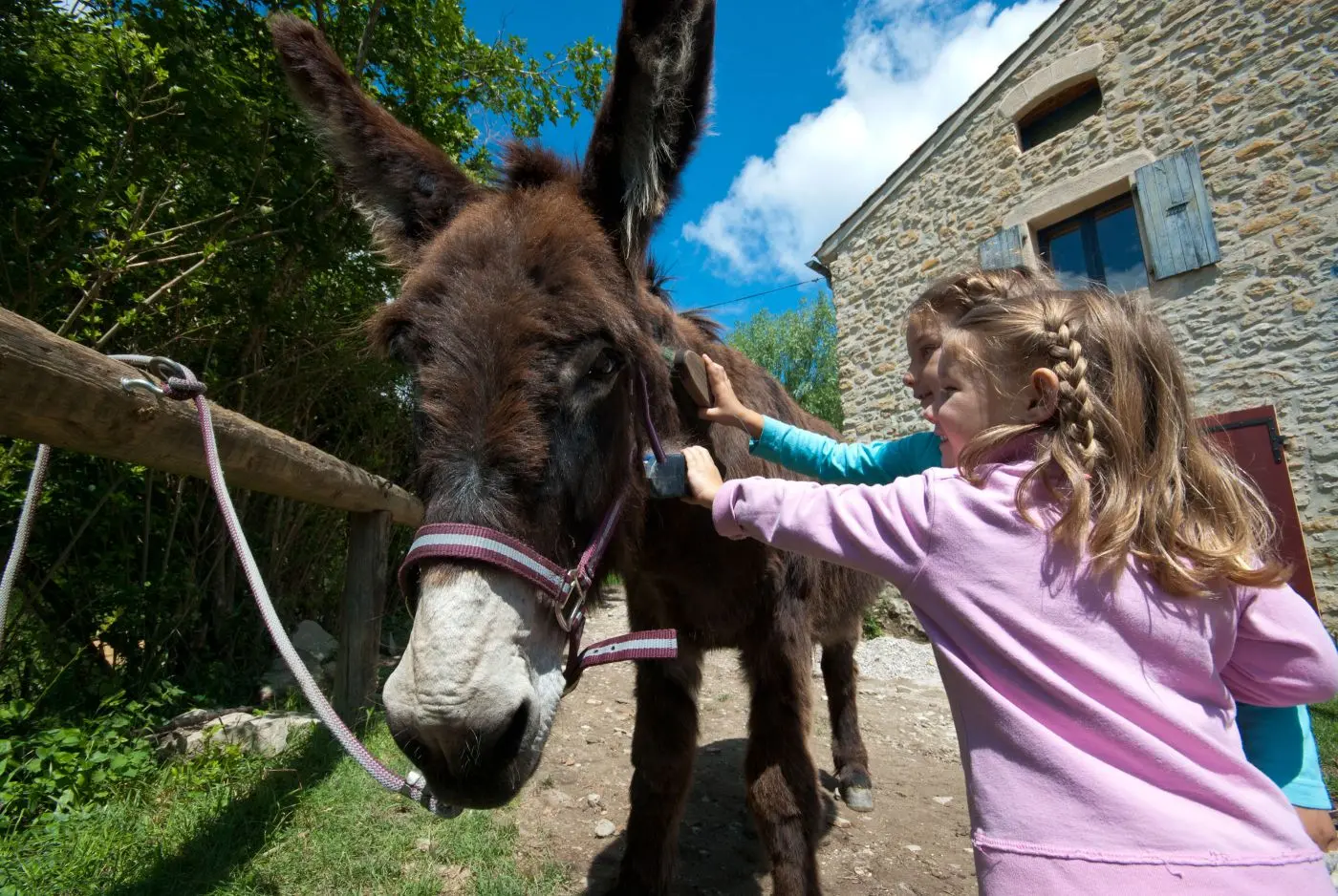
Martine “The donkey has an incredible ability to create bonds. It is very sociable and quickly becomes a partner. Children become attached very fast; they learn to care for it and to be attentive. Parents discover another way of sharing the journey, without pressure, without objectives to reach.”
With Karine, this calming dimension is almost tangible: “Even when they are lively, donkeys have a naturally slow temperament. They calm things down. I’ve seen families arrive very tense and leave transformed. Some people go away for several weeks, others do long hikes. Each time, something deep emerges.”
What the donkey offers is not just a hiking experience with an animal. It is another way of being together on holiday — more attentive, more respectful, simpler, at its own pace, with no objective other than being present.
Donkey travel goes far beyond the framework of a holiday. It offers an introduction to a respectful human–animal relationship through values of cooperation and listening. It becomes a shared memory that continues to resonate long after returning home.
Travelling with a donkey means accepting to journey differently — with a living being, at its pace, thanks to committed donkey handlers who care as much for the animal as for the quality of the experience lived by families. A donkey holiday thus becomes a precious and profound experience for both children and parents.
Meet Rachel, Martine or Karine and their companions on your next family donkey journey →