


September to November: the other walking season
We walk in France all year round, and every season has its own character. Spring opens the paths and sets the waterfalls running. Summer gives days that seem never to end, right through to the close of August.
And then September comes. The colours settle in, stags bell from the forests at dusk, the grape harvest begins. Walking changes its light without losing any of its comfort.
For thirty years now we have been running departures from April to October. We've walked these paths in spring, in the heat, in the October dew. Every period has its strengths and its limits, here are those of the late season, region by region.
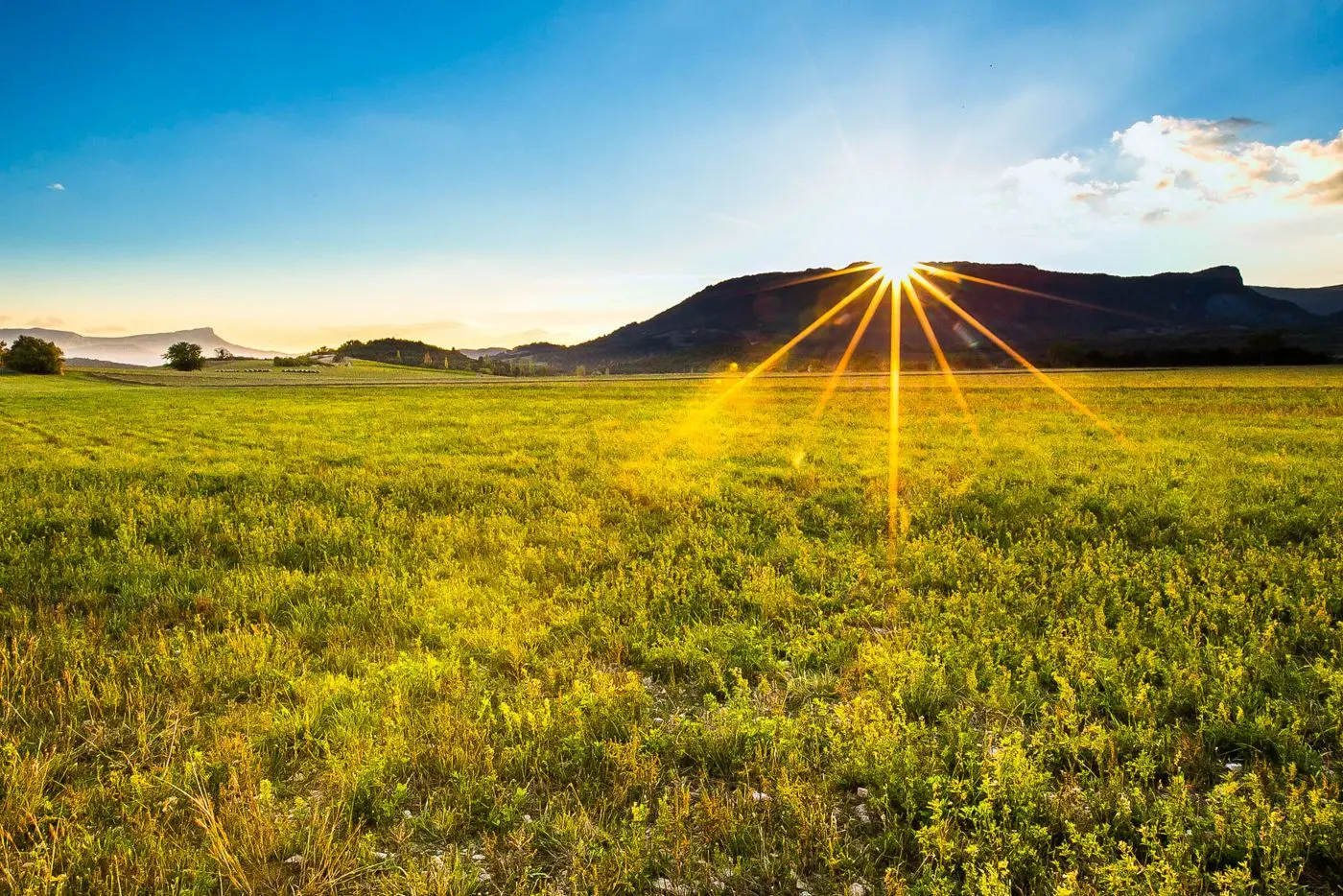
What changes from September onwards
Temperatures soften. This is the first thing you notice, and it reshapes the day. The middle of the afternoon no longer has to be worked around. You set off again after lunch, sit down by a river because nothing is pressing, and reach your night's stop without having chased the shade the whole way.
The water is at its warmest. Air warms quickly and cools quickly. The sea, the lakes and the rivers take weeks to store up heat — and just as long to give it back. That lag is what brings the Atlantic and the Mediterranean to their gentlest temperature of the year, between late August and mid-September. A swim at the end of a stage stays possible far later than you'd think.
The skies steady. In the mountains, the late-afternoon storms grow less frequent. Afternoons stop being a race against the cloud building overhead. Nothing is ever guaranteed at altitude, but the windows grow wider.
The animals show themselves. From mid-September to mid-October, the belling of stags rises from the forests at dawn and dusk. You hear it long before you understand what it is. This is also the season of the great migrations, passing in tight ranks above the Pyrenean passes, and of the descending transhumance: in the Alps, the herds leave the high pastures and cross the villages in procession, bells leading the way.
The colours arrive. Late September at altitude, through October lower down. Larches turn yellow, beeches russet, sweet chestnuts gold. On the causses, the light lies almost flat and stretches every shadow. Photographers know this.
And the pace slows. After the schools go back, the busiest paths get their breath back. You move at your own speed, you stop where you like. You can hear yourself walk.
The late season, fortnight by fortnight
This is the question we're asked most often on the telephone. Each fortnight has its strengths and its constraints.
Late August, from the 17th. Still the school holidays, but something eases after the mid-August weekend. Everything is open: accommodation, mountain refuges, terraces, markets. This is the last fortnight at summer rates.
1 to 15 September. A comfortable window, combining two things rarely given together: everything is still open, and the paths are already quiet. The light is beginning to lean. Depending on the trip, rates shift to low season. The first grape harvests get under way in the South and in Alsace.
15 to 30 September. The high mountain refuges begin to close. The belling starts. Up in the mountains the larches catch fire. The sun sets around eight in the evening: long stages remain comfortable.
October. The month of colour. The causses, the mid-mountains and the coast come into their finest light. Two things to know: night falls around seven in the early part of the month, and the change to winter time on the last Sunday brings it abruptly forward to half past five. From then on you plan your stages to arrive before four, and rediscover the pleasure of an evening by the fire.
November. The mountains have closed their shutters. But the Atlantic coast, the South and some of the causses walk beautifully, in a silence you'll find at no other time of year. We keep a few itineraries running: give us a call, it's decided case by case.
Eight regions to walk in the late season
Brittany and the GR34
The customs officers' path is arguably the finest coastal walk in Europe, and the late season suits it. The sea reaches its gentlest temperature in September. The fishing harbours find their rhythm again. And on the gorse moorland, the low October light does something photography never quite captures.
In Finistère, our itinerary runs from the Pays Bigouden to the Pointe du Raz. The world's end, quite literally. Little climbing, plenty of wind, white sand, and chapels appearing as the path turns inland.
We won't pretend otherwise: it can rain. That's the price of a coast you have largely to yourself, and the Breton sky remakes itself within the quarter hour.
When to go: September to the end of October.
👉 Brittany at the world's end, in Finistère
👉 The Pink Granite Coast, in the Côtes-d'Armor
👉 The Gulf of Morbihan
👉 Hiking in Belle-Ile-en-mer
Haute-Provence
Jean Giono's country, which he wrote about better than we ever could. By September the lavender is cut, the fields are brown and settled, and you walk from morning to evening without having to look for a tree.
The route crosses Forcalquier and Manosque, pauses at the Rochers des Mourres — a herd of mushroom-shaped stones standing in the middle of a field, whose presence remains a puzzle — then climbs the Montagne de Lure, where the air stays cooler than on the plain. The figs are ripe and the orchards carry the scent of summer's end.
When to go: September to mid-October.
👉 The Lands of Haute-Provence
The Larzac and the Cirque de Navacelles
A bare plateau, without shade and without water, where the eye carries for miles. It's exactly the kind of ground the late season makes magnificent: once the sun eases, you can walk in the open from morning to evening and let the sheer space take you over.
The Larzac is a UNESCO World Heritage site. You pass from the dryness of the causse to the sudden cool of the Vis gorges, drop down into the Cirque de Navacelles, and cross La Couvertoirade with its Templar walls. And keep an eye upward: the griffon vultures, reintroduced to the region, wheel above the plateau without a single beat of the wing.
When to go: mid-September to the end of October.
👉The Larzac, Navacelles and the Cévennes
The Quercy and the Albi bastides
An hour north of Toulouse, a country of limestone plateaux, slow rivers and medieval towns. Bruniquel, Larroque, Puycelsi, Castelnau-de-Montmirail: all listed among the most beautiful villages in France, and all clinging to their rock as though afraid of falling off it.
Autumn adds two things. The Gaillac grape harvest, which fills September and brings the lanes alive with tractors. And a cuisine made for cool days: walnuts, goat's and ewe's cheeses, duck in all its forms, the wines of Gaillac and Cahors. A region that rather makes you hope for rain.
When to go: September to the end of October.
👉 The Albi bastides and the Aveyron gorges
The Ardèche gorges, with a donkey
For families, early September is a fortunate moment. The water in the gorges is still warm, the ridges open onto the whole valley, and the caves hold stories the children will ask for again come evening.
The donkey takes care of the rest. He carries the bags, he sets the pace — slower than yours, that's the point — and he turns a walk into a companionship. We entrust only one donkey to each family: trust takes time to build, and it isn't something to share.
When to go: late August to mid-October.
👉 The Ardèche gorges with a donkey, for families
The Drôme, between Vercors and Provence
This is home. Our office is in Mirabel-et-Blacons, on the banks of the Drôme, and we have walked these paths more often than any others — sometimes for the sole pleasure of checking they're still there.
The route drops from the limestone of the Vercors down towards the first lavender, through hilltop villages and past rivers you'll happily slip into at midday. In October, the mist sometimes stays lying in the valley while the sun lights the heights. You walk then above a white sea, and understand why we never left.
When to go: September to mid-October.
👉 Hilltop villages in the Drôme Valley
The Cathar Pyrenees
From pass to pass, at around 1,300 metres, between deep forest and close-cropped upland grass. Montaillou and its ruined castle, the Frau gorges and their population of birds of prey, a view across to Montségur that leaves you quiet for a moment.
You walk with a donkey, and finish with a night in a refuge at 1,600 metres. The last stage follows the Chemin des Bonhommes, walked long ago by the final Cathars in exile. In late August and early September, the bilberry bushes of the Col de Balaguès slow progress considerably. Consider yourself warned.
When to go: late August to the end of September.
👉 The Cathar Pyrenees with a donkey
The Queyras
The highest villages in Europe, their larchwood houses darkened by the sun and their communal bread ovens, between 1,800 and 2,700 metres. Marmots, chamois, golden eagles. A night in a refuge beside a lake, where the water is freezing and nobody resists putting their feet in.
One thing to know: at this altitude the window closes early. The refuges shut between mid-September and the month's end. The first fortnight of September is therefore the season's last slot — and it's also when the larches begin to turn, which is not the least of its attractions.
When to go: until mid-September
👉 Walking in the Queyras
👉 The high villages of the Queyras with a donkey
How late can you go?
It all depends on altitude. That's the first question to ask, before even the question of region.
Above 2,000 metres, the season ends around mid-September. The refuges close, the nights turn markedly cold, and a fall of snow is nothing out of the ordinary.
Between 800 and 1,500 metres, you can walk comfortably until the end of October. It's in October that the colours are at their finest.
On the coast and in the South, the season stretches into November — provided your hosts are still there. Many close after the start of November.
A word on that last point, because it often comes as a surprise. In the late season, the difficulty isn't finding space: it's finding a house that's open. Hosts reduce their capacity before closing altogether, and a room free in July may have vanished by October without anyone having booked it. The further the season goes, the wiser it is to plan ahead.
What to put in your pack
Nothing complicated. Three things deserve particular attention at this time of year.
Dress in layers. A merino wool base layer — warm, breathable, and still fresh on the third day, which is no small thing — a light fleece over the top, and a waterproof, breathable rain jacket. Mornings are cool, afternoons can be warm. You add, you take off, you start again.
Look after your feet. Mid or high-cut boots that support the ankle and hold out against damp, with wool socks. The morning dew wets the grass far more than you'd imagine.
Carry a head torch. This is the classic late-season oversight. In October, a stage that runs an hour long finishes in the dark. A head torch weighs eighty grams and saves the end of a day.
In October and at altitude, add a hat and thin gloves. They may not be needed. If they are, you'll remember it for a long time.
What exactly is self-guided walking?
You walk on your own, with family or with friends, at your own pace, without a guide and without a group to wait for. We take care of the rest: accommodation booked, bags travelling ahead of you from stage to stage, your route prepared and delivered through our navigation app, and a team you can reach if something goes wrong.
Most of our trips depart any day of the week. You choose your dates, we check availability.
And if you're unsure about the timing, call us. We have walked these paths, often in several seasons, and we'll tell you plainly whether the window you have in mind matches what you're looking for.
See all our walking holidays Our journeys with a donkeyWritten by Yvann, Safrantours
Frequently asked questions
-
Can you go walking in France in September?
Yes, and it's a very favourable time in most regions: mild temperatures, days still long, accommodation open. In the high mountains, choose the first fortnight; on the coast and in the South, the season continues into October.
-
Is it too cold for walking in October?
No, provided you dress in layers and allow for the short days. In the mid-mountains and on the causses, October brings the finest colours of the year. Above 2,000 metres, however, the season is over.
-
Can you still swim in September?
Yes. The sea and the rivers reach their gentlest temperature between late August and mid-September, and swimming stays pleasant into early October in the Mediterranean.
-
Are mountain refuges open in September?
Only some of them. High-altitude refuges generally close between mid-September and the end of the month. That's why our high mountain trips finish in mid-September, while the mid-mountain itineraries carry on into October.
-
Do you need to book far ahead to travel in September?
A few weeks is usually enough. The constraint isn't the crowds but the gradual closing of accommodation: the further the season goes, the smaller the choice.
-
When is the best time of year to walk in France?
It depends what you're looking for. Spring brings the flowers, full waterfalls and a landscape waking up. Summer gives the longest days and access to the high mountains. The late season brings colour, mildness and quiet paths. Our itineraries run from April to October: tell us what draws you, and we'll tell you when to go.